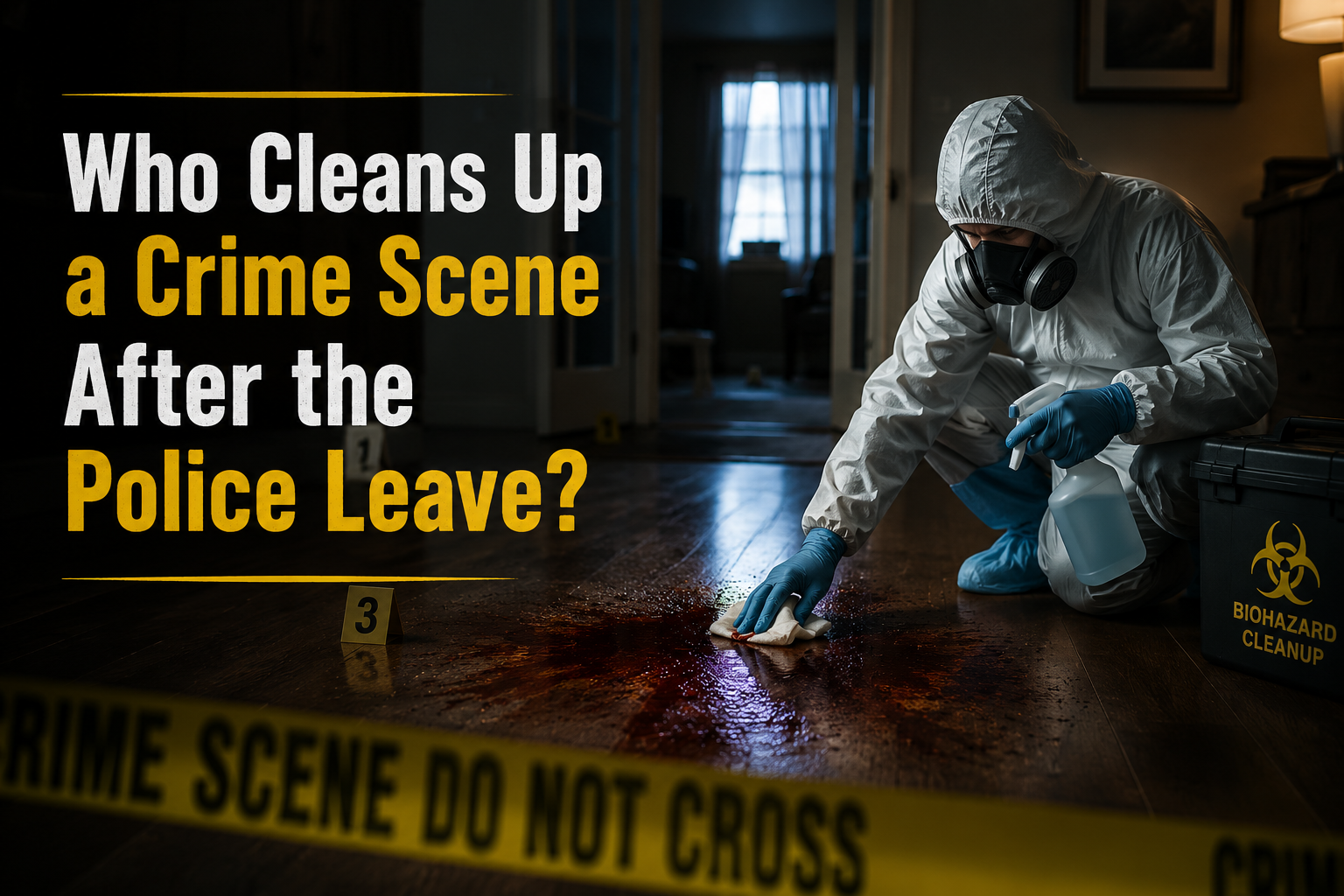
 When a crime or a traumatic death happens in a home or business, the arrival of police, paramedics, and investigators is only the first chapter. Once the scene is documented and released, everyone leaves — and the property is handed back to its owner or the victim’s family, often exactly as the incident left it. In that moment, one difficult and surprising question tends to surface: who cleans up a crime scene after the police leave?
The short answer catches most people off guard. This guide explains who is actually responsible, what the authorities do and don’t handle, why crime and trauma scene cleanup is not a job for family or building staff, and how the costs are typically covered in British Columbia. It is written to be practical and clear at a time when clarity is hard to come by. Please note that it is general information, not legal or insurance advice.
Who cleans up a crime scene? The short answer
Police, paramedics, and coroners do not clean up crime or trauma scenes. Their role is to respond, investigate, and document. Once a scene is released, responsibility for cleanup and decontamination falls to the property owner, the occupant, or the deceased’s family or estate — not to any government agency. Because these scenes involve blood and other biohazards, that responsibility is almost always passed to a licensed professional crime scene cleanup company with the training, equipment, and legal authorization to remove biohazardous material safely. In other words, the people left to arrange cleanup are usually the ones least prepared for it — which is precisely why professional help exists.
What the police and authorities actually do — and don’t
It is a common and completely understandable assumption that if the police attend a scene, someone official handles the aftermath. In reality, each responder has a narrow role:
- Police and investigators secure the scene, gather evidence, and document what happened.
- Paramedics and medical staff treat and transport the injured.
- The coroner or medical examiner attends in the case of a death and arranges removal of the deceased.
Once these tasks are complete and the scene is formally released, the property is returned to the owner or family. Cleaning, decontaminating, and restoring it is not part of any of these agencies’ responsibilities. That work — and its cost — sits with whoever owns or is responsible for the property.
So who is responsible for the cleanup?
Responsibility depends on the property and the situation, but it generally falls to one of the following:
- Homeowners — a homeowner (or their family) is responsible for cleanup of their own residence.
- Family or estate of the deceased — after a death at home, responsibility commonly falls to the next of kin or the estate.
- Landlords and property managers — for a rental, the property owner is typically responsible for restoring the unit, though specifics can depend on the tenancy agreement and circumstances.
- Business owners — commercial property owners are responsible for their premises, with the added duty of protecting employees from exposure.
No matter who holds responsibility, the safe and practical path is the same: bring in professionals rather than attempting it in-house.
Why crime and trauma scene cleanup is never a DIY job
It is natural to want to spare the family a cost, or to simply “handle it.” But crime and trauma scenes are among the most hazardous cleanup jobs there are, for reasons that are not obvious at first glance.
Blood and bodily fluids can carry bloodborne pathogens such as hepatitis and other infectious agents, and contamination spreads far beyond what the eye can see — into flooring, subfloor, drywall, and other porous materials. Ordinary household cleaners do not disinfect to the required standard, and improper handling can expose people to infection or spread contamination through the rest of the property. There is also the matter of the residues investigators leave behind — fingerprint powder, luminol, and sometimes tear gas — which carry their own hazards and can damage belongings.
Finally, biohazardous waste cannot simply be bagged and put in the trash. It must be contained, transported, and disposed of in accordance with provincial and federal regulations, by a company licensed to transport hazardous waste. Doing this incorrectly is both unsafe and unlawful. Professional crime scene cleanup exists precisely because the work demands training, protective equipment, proper disinfectants, and legal authorization that households and building staff simply do not have.
Who pays for crime scene cleanup in BC?
Cost is understandably one of the first worries, and the reassuring news is that families are often not left to shoulder it alone.
Insurance. Many homeowner’s and property insurance policies include coverage for biohazard or trauma cleanup, though the amount and conditions vary by policy. A reputable cleanup company can usually work directly with insurers and help document the claim.
Victim assistance. British Columbia operates programs intended to help victims of crime with certain costs, which in some circumstances may extend to cleanup. Eligibility and coverage are specific and change over time.
Because coverage differs case by case, the practical first step is to contact a professional cleanup company early — they handle these situations regularly and can explain the likely options for your circumstances. Again, this is general information, not insurance or legal advice.
What professional cleanup actually involves
A qualified crime and trauma scene cleanup company follows a formal, staged process rather than simply “cleaning.” At Urban Environmental, that means containment of the affected area; methodical cleaning and disinfection in stages using field-tested agents; and the detection, disinfection, and complete removal of all traces of biohazardous material and infectious waste — including tissue, bodily fluids, contaminated household goods, and sharps such as needles or razor blades. All biohazard waste is then packaged and removed in accordance with provincial and federal regulations. The goal is not only a clean property, but one restored to its original condition — safely and discreetly.
How to choose a crime scene cleanup company
Because this is a service most people hire only once, and under stress, it is worth knowing what separates a legitimate company from the rest:
- Proper licensing to transport and dispose of hazardous waste
- WorkSafeBC (WCB) clearance and liability insurance
- Trained technicians and a documented containment-and-disinfection process
- Discretion, compassion, and rapid response
- Willingness to work with your insurer
Urban Environmental meets each of these. We are WCB-cleared, insured, and licensed to transport hazardous waste, and we serve homes and businesses across Metro Vancouver, the Fraser Valley, and the wider Lower Mainland with technicians who can be on site as quickly as you need them.
Frequently asked questions
Do the police clean up a crime scene?
No. Police, paramedics, and the coroner respond to, investigate, and document a scene, and arrange removal of the deceased — but cleanup and decontamination are not their responsibility. Once the scene is released, that falls to the property owner or family.
Who is responsible for cleaning up after a death at home?
Responsibility generally falls to the homeowner, or to the next of kin or estate of the deceased. For rentals, it typically falls to the property owner. In practice, a licensed biohazard cleanup company is hired to do the work safely.
Can I clean up a trauma scene myself?
It is strongly discouraged. Blood and bodily fluids can carry infectious pathogens, contamination spreads into hidden materials, and biohazard waste must be disposed of legally by a licensed company. It is a health and legal risk, not merely an unpleasant task.
Does insurance cover crime scene cleanup?
Many home and property policies include some biohazard or trauma cleanup coverage, though this varies by policy. A professional company can often bill insurers directly and help with the claim.
How quickly can cleanup begin?
Once the authorities have released the scene, a professional company can usually respond quickly. Urban Environmental can have technicians on site across the Lower Mainland as fast as you need them.
Key takeaways
- Police, paramedics, and coroners do not clean up crime or trauma scenes — they respond, investigate, and remove the deceased.
- Once a scene is released, cleanup responsibility falls to the property owner, occupant, or the deceased’s family or estate.
- It is not a DIY job: biohazards, hidden contamination, investigator residues, and strict waste-disposal laws make professional cleanup essential.
- Costs are often covered, at least in part, by home or property insurance and possibly victim-assistance programs — confirm the specifics for your situation.
- Choose a company that is licensed for hazardous waste, WCB-cleared, insured, and discreet.
We’re here when you need us
Facing the aftermath of a crime or traumatic loss is one of the hardest things a family or business can go through, and arranging cleanup should not add to the burden. Urban Environmental has long been a trusted name in crime and trauma scene cleanup across Vancouver and the Lower Mainland, handling every job with thoroughness, discretion, and care. If you need help, call us at 604-299-0379 or request a quotation — technicians can be on site as quickly as you need them.