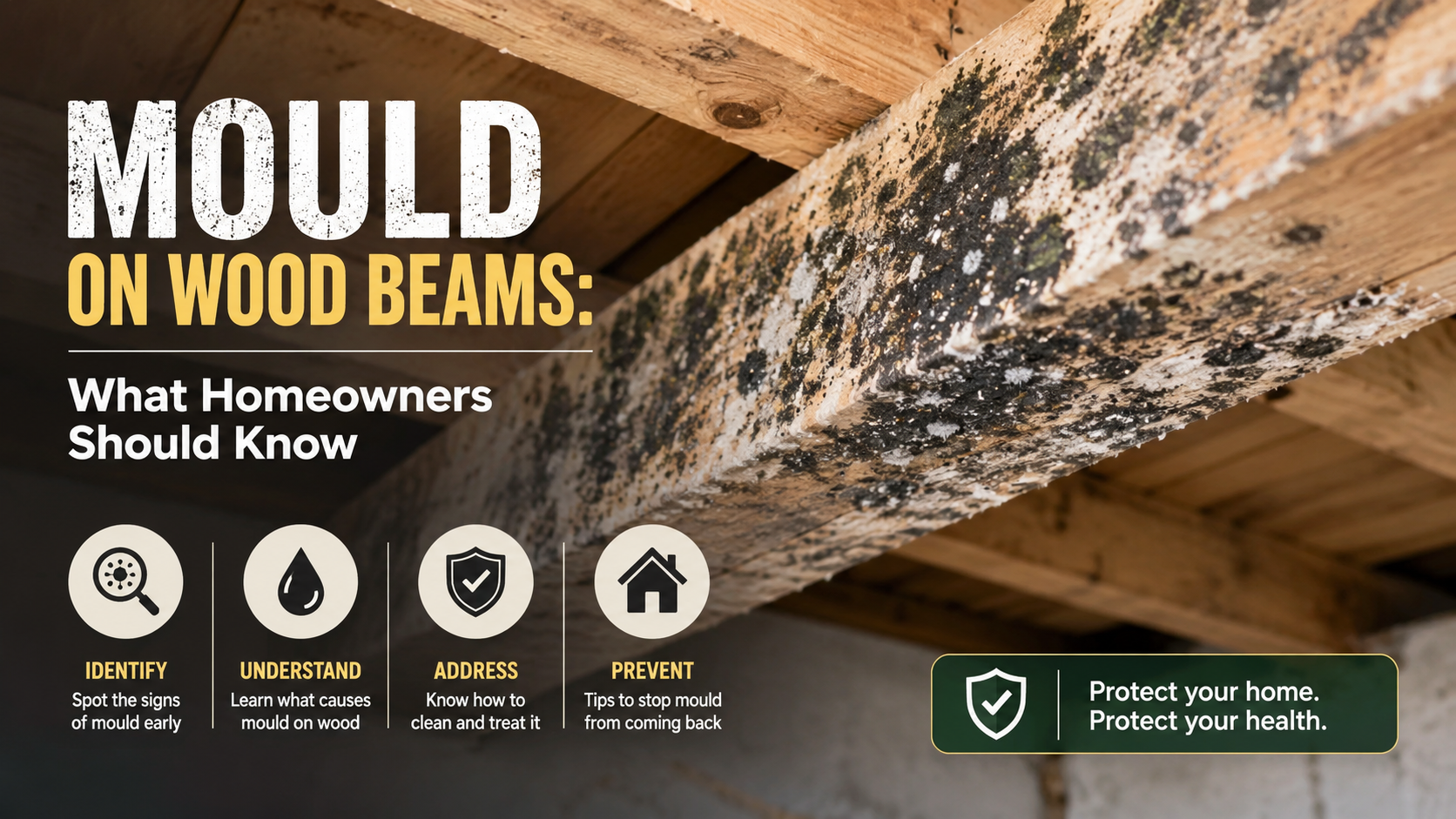
Mould on Wood Beams: What Homeowners Should Know

Every structure has a story to tell; the structure of your house has a story written in the structure of everything around you; beams of wood are keeping your floors, attic, and walls together, and they have weathered countless storms during the years, they have outlived many seasons. The only thing that’s going to ruin that story is a little thing called mould. It kills the wood very slowly, giving it plenty of time to make itself comfortable and become a permanent resident of the wood beams in your house. Most homeowners will never see how serious a problem mould in their home is until it has made itself at home for quite some time. Therefore, mould on wood beams is one of the most overlooked dangers to the future of a house as well as the people living in it.

Why Wood and Mould Are Such Dangerous Companions

For fungal growth, wood is essentially a 5-star hotel. It is extremely porous and retains moisture, plus it has lots of organic material for the spores of moulds to use for food. For mould to grow, all it needs is to be between 2°C-40°C, humidity levels are above 60%, plus it needs to be a little dark. Your attic, basement or crawlspace basically gift wraps these conditions to mould all year round.

Once the spore lands on a damp beam and establishes itself, you can expect to see evidence of mould within 24 to 48 hours. In a matter of weeks, what started as a small fuzzy patch will develop into a vast network of hyphae (the thread-like roots of the mould) that continues to invade further and further into the fibres of the wood.

This issue is not merely aesthetic either. This is just the start of structural mould damage.

The Hidden Architecture of the Problem

Homeowners mostly only notice mould when it is visible, such as on the ceiling of the bathroom, the wall of the basement, or in the corner behind a washing machine. However, attic mould is common and dangerous, mainly because people do not check them often enough.

Attics are very susceptible to mould for many reasons. They are subject to roof leaks that, even if they are small, cause water to drip directly onto structural lumber. There is also no way for moisture trapped in the warm humid air to escape from wood surfaces until that humid warm air is removed by airflow. Kitchen and bathroom exhaust fans that vent into an attic instead of outside also release moisture into an attic by pumping hot wet air directly onto the supports (i.e., beams) that support the roof over head. The result is an accumulation of moisture, without any evidence of it, that allows mould to grow and become established within the structure of a home.

Urban Environmental inspectors have found Stachybotrys chartarum (commonly known as “black mould”) growing on attic beams that the homeowner had no idea about. Black mould is very aggressive, and it can produce mycotoxins that will become airborne and circulate throughout the ventilation system within a house to negatively impact indoor air quality, as evidenced by respiratory issues, headaches, fatigue, and severe allergic reactions in sensitive individuals.

Reading the Signs Before It’s Too Late

Mould that exists on wood beams can cause serious damage to a house but often the worst of this damage will not be seen by homeowners because it occurs out of sight. However, if you know what to look for, you can see some of the signals that indicate the presence of mould.

The first and most obvious indicator of mould presence is discolouration. Greyed wood, dark streaks along the beams and fuzzy green, white or black patches on wood beams indicate the presence of an active colony of mould. A musty/earthy smell is another indicator of mould presence. The “musty” smell will be present long before any other visual signs of mould will be present; especially in enclosed spaces such as attics and/or crawl spaces. The “musty” smell is an indication of the off gassing of the by-products of the mould metabolic processes and is a visual indication for what can not be seen.

A later stage indicator of mould present on wood beams is the warping/softening of the wood itself. When mould has been feeding on a wood beam long enough to weaken the wood enough to lose its structural integrity or cause the creation of small cracks and/or soft spots (on drywall) near supporting points.

When you see any of these indications of structural damage by mould on wood, you really should contact a professional inspector.

What Wood Mould Removal Actually Involves

Here’s a truth many DIY methods won’t tell you: The wood mould removal from structural beams is not a 2-day do-it-yourself project.

The old trick of using bleach to clean surfaces works for cleaning off the surface of mould, but since wood is a porous material, bleach cannot penetrate the surface of the wood effectively. Any roots of mould on the beam will regrow, many times worse than before. You’re not fixing the problem; you’re only causing the mould to temporarily retreat.

The correct way to remove mould from wood by a professional involves the following:

  1. Containment: the contaminated area must be isolated from the rest of the house to avoid the spread of mould spores to the remaining clean areas of your house during the hazmat removal process of contamination.
  2. Removal: If you have a severe mould infestation, some of the beam will need to be removed and replaced because you cannot repair wood beyond a certain depth with a product.
  3. Treatment: After the mould is removed, a special antimicrobial product will be applied to the affected areas, as well as the surrounding areas, to stop any mould from coming back.
  4. Drying/Monitoring: The source of the moisture will need to be identified and corrected in order for mould to not return.

We take the same full-cycle approach to every mould remediation job at Urban Environmental, because we don’t want to make money providing the same service to you over and over by addressing the symptom and not the root cause!

The Indoor Air Quality Consequence You Can’t Ignore

One of the least considered aspects of mold on wooden beams is how it impacts the quality of the air we breathe on a daily basis. Air in buildings becomes significantly contaminated with mold spores and mycotoxins as mold grows and reproduces, so when there are active colonies of mold growing in structural materials in the building, there will be a significant decrease in indoor air quality.

The World Health Organization has stated that mold exposure contributing to indoor air quality has resulted in chronic respiratory diseases and an increase in the severity of asthma and decreased lung development in very young children. Since most people spend more than 90% of their lives indoors, this is not an issue that can be overlooked — this is an issue that needs to be addressed.

This is why Urban Environmental performs air quality testing in conjunction with all structural mold removal, providing a clear before-and-after photo showing what the results of the removal efforts actually accomplished.

Prevention Is Significantly Cheaper Than Cure

If there’s one thing that a decade of environmental remediation work teaches you, it’s that the homeowners who invest in prevention spend a fraction of what those who wait until crisis hits will eventually pay.

Inspect your attic and crawl spaces at least once a year, particularly after heavy rainfall or winter. Ensure all exhaust fans vent to the outside. Maintain gutters and downspouts so water is directed well away from your foundation. Monitor indoor humidity with an inexpensive hygrometer and keep levels below 55%.

And if you’re buying a home? Always insist on a mould inspection before you sign. What’s hid den in the beams above and below your living space matters every bit as much as what the estate agent is showing you.

What Does a Professional Biohazard Cleanup Company Do?

A property manager in New Westminster gets a call on a Tuesday afternoon. A tenant has been found deceased in a third-floor suite, and the coroner’s service has finished its work. The RCMP tape is down. The unit is now, officially, the property manager’s problem — and nobody at the property management office has any idea what happens next.

That gap is where most people first encounter this industry. The authorities investigate, document, and remove the deceased. What they do not do is clean. Once a scene is released, restoring the property to a safe, habitable condition falls to the owner, the executor, the strata, or the employer — and it is not a job for a mop and a bottle of bleach.

This article explains, in practical detail, what a professional biohazard cleanup company actually does: how contamination gets assessed, what the crew physically does inside the containment, which regulations govern the work in British Columbia, what happens to the waste, and how anyone can tell whether a company is genuinely qualified or just confident. If you are trying to make a decision quickly and under stress, the short answer comes first.

The short answer

A biohazard cleanup company is a specialist remediation contractor that assesses, contains, removes, decontaminates, and lawfully disposes of biological contamination — blood, bodily fluids, tissue, decomposition residue, sewage, and pathogen-bearing materials — then verifies that the space is safe for people to reoccupy.

The work has four defining characteristics that distinguish it from cleaning:

  1. It begins with a contamination assessment, not a quote for square footage.
  2. It is performed inside engineered containment with respiratory protection and controlled airflow.
  3. It treats the removed material as regulated waste, tracked from the property to a licensed disposal facility.
  4. It ends with documented verification, not a visual once-over.

Remove any one of those and it stops being remediation.

What actually counts as a biohazard

“Biohazard” is a broader category than most people assume, and the scenes are more varied than television suggests. In practice, a biohazard cleanup company is called for:

  • Unattended deaths. A death discovered days or weeks later. Decomposition releases fluids that migrate through flooring, subfloor, and drywall, and volatile compounds that saturate porous materials well beyond the visible area.
  • Trauma and crime scenes. Scenes involving significant blood loss, including after police and coroner release.
  • Suicide. Handled with the same technical rigour and considerably more care for the family present.
  • Sewage backups and Category 3 water losses. Sewage carries bacterial, viral, and parasitic loads and is treated as grossly contaminated.
  • Infectious disease decontamination. Post-outbreak cleaning of workplaces, care facilities, transit vehicles, and shared housing.
  • Hoarding and severe neglect conditions. Often a compound problem: biological contamination layered with pest infestation, mould, and structural damage.
  • Drug-involved sites. Discarded needles, sharps, and residue in vacated units or public-facing properties.
  • Animal decomposition and infestation aftermath. Including attic, crawlspace, and wall-cavity contamination.

Urban Environmental’s own service framing groups the hazards by route of transmission — airborne, bloodborne, and vector — which is a genuinely useful way to think about it, because the route determines the control.

Airborne pathogens travel in respirable aerosols and droplets. They drive the requirement for HEPA filtration, negative or positive air pressure, and fitted respiratory protection.

Bloodborne pathogens — hepatitis B, hepatitis C, HIV among them — transmit through mucous membranes and breaks in the skin. They drive PPE selection, sharps handling protocols, and the assumption that all blood is infectious regardless of what anyone knows about the individual.

Vector-borne contamination arrives with the insects and animals that a decomposing body or a hoarding condition attracts. Vectors spread material well past the origin point, which is why an experienced crew scopes a much larger area than the obvious one.

That last point deserves emphasis, because it is the single most common thing homeowners get wrong: contamination is almost always larger than it looks. Fluid follows gravity and capillary action. It travels along joists, under laminate, down through subfloor seams, into wall cavities, and along the underside of flooring where nothing is visible from above. A stain the size of a dinner plate on carpet can mean two square metres of contaminated subfloor beneath it.

Why this is not a cleaning job

There is a persistent assumption that biohazard work is just intensive cleaning performed by people with strong stomachs. It is closer to the opposite: the emotional difficulty is real, but the technical difficulty is what makes it a licensed trade.

Consider what a general cleaning crew cannot do:

  • They cannot conduct a hazard assessment or write the exposure control plan that provincial regulation requires before workers are exposed to a biological agent.
  • They cannot build containment. Sealing a work area and controlling its air pressure so contaminants do not migrate into the rest of the building requires equipment and a plan.
  • They cannot legally transport the waste. Contaminated material is not household garbage, and moving it requires specific packaging and, depending on classification, licensing.
  • They cannot verify the result. Disinfectant on a surface is not proof of decontamination. Verification requires documented protocol and, where warranted, testing.
  • They cannot remediate structure. Porous materials that have absorbed biological material generally cannot be cleaned. They have to come out, which means controlled demolition — and knowing how to do that without spreading contamination.

There is also a liability dimension that property owners underestimate. If contamination is left in place and a subsequent occupant becomes ill, or if an untrained person is exposed during a DIY attempt, the documentation of what was done — and by whom, to what standard — matters enormously. A qualified contractor produces that record as a matter of course.

What professional biohazard cleanup actually involves, step by step

Every scene differs, but competent work follows a recognisable sequence. This is what a properly run project looks like from intake to release.

1. Intake and confirmation of scene release

The first call establishes what happened, where, when it was discovered, who has jurisdiction, and whether the scene has been formally released by police or the coroner. No legitimate contractor enters an active scene. If an investigation is ongoing, the crew waits.

Intake also establishes who is authorising the work — owner, executor, strata, insurer, or employer — because that determines the paperwork.

2. On-site contamination assessment

A technician attends and performs a contamination assessment: mapping the affected area, identifying the extent of migration, probing beneath flooring where necessary, checking adjacent rooms and the level below, assessing HVAC involvement, and identifying secondary hazards. Older Lower Mainland housing stock adds a wrinkle here — a project in a pre-1990 building may uncover asbestos-containing materials or vermiculite, which means the scope expands to include abatement before any demolition proceeds.

The assessment produces the scope of work, the containment plan, and the estimate. It is also the point at which a good contractor tells you plainly what can be salvaged and what cannot.

3. Hazard assessment, exposure control, and PPE

Before anyone enters, the hazards are documented and controls are selected. In British Columbia this is not discretionary. The WorkSafeBC Occupational Health and Safety Regulation requires an employer whose workers face occupational exposure to a designated biological agent to have a written exposure control plan covering, among other things, infection-control precautions, housekeeping practices to keep the workplace free from spills and accidental contamination, procedures for handling contaminated laundry, a description of the PPE selected to minimise exposure, and a program to train and supervise workers accordingly.

The regulation also codifies the precautionary principle — where the identity or transmission route of an agent has not been established, workers adopt provisional precautions covering all routes, at a higher level of protection. In plain terms: when in doubt, over-protect. That principle is why crews suit up the same way whether or not anyone knows the deceased person’s medical history.

Typical protection includes full-body coveralls, nitrile gloves (frequently double-gloved), eye protection, and respiratory protection appropriate to the assessed hazard, with fit-testing and decontamination procedures for removing it without self-contaminating.

4. Containment and engineering controls

The work area is isolated — doorways and openings sealed with polyethylene sheeting, HVAC registers closed off, and a decontamination path established so technicians can enter and exit without tracking material through the building.

Airflow is then controlled deliberately. HEPA air filtration devices scrub airborne particulate, and the containment is set to either negative or positive pressure depending on the objective. Urban Environmental notes using positive-pressure environments for post-viral decontamination work, so that air moves outward rather than drawing in from unfiltered spaces, combined with HEPA cabinet air scrubbing to capture biological contaminants. For decomposition and trauma work, negative pressure is more typical, holding contaminants inside the containment. Either way, the point is the same: air is a transport medium, and unmanaged air undoes the rest of the job.

5. Gross removal and contents triage

Bulk contaminated material comes out first. Furniture, mattresses, upholstery, bedding, carpet and underlay are assessed individually. Where an item is large but only partly affected — a sofa or mattress is the common case — the crew cuts out and separates the contaminated section rather than manoeuvring a saturated whole item through the building. Removed material goes directly into rated biohazard containers within the containment.

Contents triage is where families feel the loss most sharply, and where an experienced crew earns its reputation. Non-porous items — metal, glass, sealed hard plastics, some finished wood — can often be cleaned and returned. Porous items that have absorbed biological material generally cannot. Documents, photographs, and irreplaceable personal effects sit in a difficult middle ground and should be raised explicitly during the assessment, not discovered in a disposal bin afterward.

6. Structural remediation

Once the contents are out, contaminated building materials are removed: carpet and underlay, laminate and its substrate, affected subfloor sections, baseboard, drywall to a defined height, and insulation where fluid or odour has penetrated. Cuts are planned to a margin beyond confirmed contamination rather than to the visible edge.

This phase is hazardous material removal in the literal sense, and it is where the crossover with a company’s abatement and demolition capability matters. Selective demolition inside an occupied building, without spreading what you are trying to remove, is a specific skill.

7. Cleaning and professional disinfection

With porous materials gone, remaining surfaces are cleaned and disinfected — in that order, and the order is not negotiable. Disinfectants are deactivated by organic soil, so applying product to a surface that still carries residue accomplishes very little. Competent crews work in stages: detergent cleaning to remove the organic load, rinse, then application of an appropriate registered disinfectant.

Professional disinfection hinges on two details amateurs miss. The first is dwell time — the manufacturer-specified period a surface must stay visibly wet for the claimed kill. Wiping a product off after thirty seconds when it requires ten minutes produces a clean-looking, undisinfected surface. The second is product selection matched to the organism, since disinfectant efficacy claims are specific rather than universal.

Surfaces are then re-cleaned to remove chemical residue, and the process is repeated where the assessment calls for it.

8. Odour and residual treatment

Decomposition odour is caused by volatile compounds that have absorbed into materials, which is why masking agents fail and why odour returning after a week is a reliable sign the source was never fully removed. Genuine odour resolution is a source-removal problem first. What remains afterward is addressed with sealing of remediated substrates and appropriate treatment of the air and structure.

9. Regulated waste packaging, transport, and disposal

This stage is invisible to the client and is one of the clearest markers of a legitimate contractor.

Biohazardous waste is packaged in containers appropriate to its classification, labelled, manifested, and taken to a facility licensed to receive it. Where material meets the criteria for Class 6.2, Infectious Substances under Canada’s federal Transportation of Dangerous Goods Regulations, packaging must comply with the CAN/CGSB-43.125 standard covering packaging of Category A and Category B infectious substances and clinical, biomedical, or regulated medical waste. Class 6.2 is divided into Category A and Category B, with Category A representing the higher hazard and each category carrying its own packaging requirements.

Practically, this means a qualified contractor can tell you where your waste went and produce documentation proving it. Urban Environmental publishes its licence to transport hazardous waste on its website, which is the kind of thing worth asking any contractor to show you.

10. Confirmation of cleaning

Professional work ends with verification, not with the crew’s opinion. The industry standard of care here is the ANSI-accredited ANSI/IICRC S540 Standard for Trauma and Crime Scene Cleanup, now in its second edition (2023), which defines the criteria and methodology for inspecting and investigating blood and other potentially infectious material contamination, establishing work plans and procedures, and — as a distinct final component — confirmation of cleaning. The standard assumes throughout that scenes have already been released by law enforcement or regulatory agencies.

Verification may include documented visual inspection under adequate lighting, moisture readings on remediated substrates, ATP or protein residue testing on surfaces, and photographic records from pre-work through completion. The deliverable is a written report, which matters for insurance claims, real estate disclosure, estate administration, and any future dispute.

11. Reconstruction and handoff

Remediation leaves a clean but incomplete space — missing flooring, drywall cut back, subfloor exposed. Reconstruction is a separate scope: replacing structure, finishing, painting, and returning the room to usable condition. Some clients want the same contractor to carry it through; others hand it to their own trades. Clarify which at the estimate stage so there is no gap in expectations.

The regulatory framework in British Columbia

Biohazard remediation in BC sits at the intersection of three regulatory layers, and a contractor who cannot speak to all three is a risk.

Layer Instrument What it governs
Provincial — worker safety WorkSafeBC OHS Regulation, Part 5 (chemical and biological agents) and Part 6 (substance-specific requirements) Written exposure control plans, infection-control precautions, PPE selection, worker training and supervision, the precautionary principle
Federal — transport Transportation of Dangerous Goods Regulations, Class 6.2 Infectious Substances; CAN/CGSB-43.125 packaging standard Classification, packaging, marking, documentation, and training for transporting infectious substances
Industry — standard of care ANSI/IICRC S540 (2nd ed., 2023) Hazard assessment, work plans, biocide technology, structural and contents remediation, waste handling, confirmation of cleaning

Provincial waste-handling requirements and municipal disposal rules apply on top of these, as do occupational hygiene requirements where a project uncovers asbestos, lead, or mould and pulls additional parts of the OHS Regulation into scope. The IICRC standard itself notes that where substances like asbestos, lead, or mould are encountered, additional expertise from indoor environmental professionals may be required.

One practical implication for property owners: if your building predates the 1990s and remediation requires cutting into flooring, walls, or insulation, expect the scope to include hazardous materials testing before demolition. A contractor who proposes cutting drywall in a 1978 house without addressing that is cutting corners you will hear about later.

Who is actually responsible for the cleanup?

This is the question that catches people off guard, so it deserves a direct answer.

Emergency services do not clean. Police secure and investigate. The coroner’s service attends to the deceased. Ambulance crews treat and transport. When their work is finished, the scene is released, and remediation becomes a private responsibility. Urban Environmental’s own crime and trauma scene material makes the same point: after a site is released by the authorities, additional cleanup, decontamination, and odour control may be required that is not the authorities’ responsibility.

Who bears it depends on the situation:

  • Owner-occupied home: the owner, or the estate’s executor if the owner has died.
  • Rental property: typically the landlord, with recovery from the tenancy or estate a separate legal question.
  • Strata: allocation between the strata corporation and the owner depends on where the contamination is and what the bylaws say.
  • Workplace: the employer, who also carries the worker-safety obligation.
  • Vehicle: the owner or their insurer.

Insurance frequently covers biohazard remediation, and many contractors work directly with adjusters. Whether a specific policy responds — and to what limit — is a question for the insurer, not the contractor.

Certified biohazard cleaners versus general cleaning services

Certified biohazard cleaners General cleaning / janitorial
Starting point Documented contamination assessment Visual inspection and hourly quote
Worker protection Written exposure control plan, fitted respiratory protection, decontamination procedures Household gloves; often none
Containment Sealed work area, HEPA filtration, controlled air pressure None
Scope of removal Contaminated structure removed to a margin beyond confirmed spread Surface cleaning only
Disinfection Clean-then-disinfect staging, registered product matched to hazard, observed dwell time Consumer disinfectant, wiped off immediately
Waste handling Rated containers, manifested, licensed transport and disposal Municipal garbage
Verification Documented confirmation of cleaning, written report None
Liability record Photographic and written documentation for insurers and future occupants None

What to expect, and what drives the price

Honest answer: nobody can quote this accurately over the phone, and a contractor who gives you a firm number sight-unseen is guessing.

Duration and cost are driven by:

  • Time elapsed before discovery — the single largest variable in a decomposition scene.
  • Extent of migration into subfloor, wall cavities, and the level below.
  • Porous material volume — carpet and upholstery versus tile and concrete.
  • Structural involvement — whether flooring and drywall must come out.
  • HVAC involvement, which can expand scope dramatically.
  • Secondary hazards — asbestos, vermiculite, mould, pest infestation.
  • Access — third-floor walk-up versus ground-level with parking.
  • Volume of contents requiring triage, particularly in hoarding conditions.

How to vet a biohazard cleanup company: ten questions

Most people hiring this service have never hired it before and are doing so on the worst day of their year. These questions separate qualified contractors from opportunists quickly.

  1. Do you have a written exposure control plan for biological agents, and can I see that one exists? A contractor who does not know what this is should not be on your property.
  2. What certifications do your technicians hold? Ask specifically. IICRC Trauma and Crime Scene Technician certification is the relevant credential; ask which technicians on the crew hold it.
  3. Are you licensed to transport hazardous waste, and where will my waste go? Ask to see the licence and to receive disposal documentation.
  4. Will you provide a written scope and a completion report? Both should be standard.
  5. How will you verify the space is clean? Listen for method — testing, moisture readings, documented inspection — not reassurance.
  6. How will you handle containment and air management? Ask which direction the air moves and why.
  7. What happens if you find asbestos or mould? In older BC housing this is likely, and the answer should be a clear process, not surprise.
  8. What can be salvaged, and how do you handle personal effects? Ask before work starts, not after.
  9. Are you insured and WorkSafeBC-registered, and are your workers covered? Uninsured labour on your property becomes your exposure.
  10. Who is my point of contact for the duration? Continuity matters when the situation is already difficult.

Common mistakes property owners make

Attempting it themselves. Understandable, and the most consequential error on this list. Beyond the exposure risk, DIY attempts routinely spread contamination — a shop vacuum without HEPA filtration aerosolises what it picks up, and cleaning fluid pushed across a floor drives it into seams.

Hiring a general cleaner because they were available sooner. The cost of remediating a job that was done badly the first time exceeds the cost of doing it correctly.

Accepting masked odour as resolved odour. If it smells like fragrance rather than nothing, the source is still there.

Skipping documentation. In BC, material facts about a property can carry disclosure implications on sale, and estates and insurers both ask for records later. Get the completion report.

Delaying the call. Decomposition contamination worsens measurably each day. Every day of delay expands the scope and the invoice.

Ventilating the space by opening everything up. Intuitive and counterproductive: it moves contaminated air into the rest of the building and, in a multi-unit property, into your neighbours’ problem.

Practitioner notes

A few things that experienced crews know and brochures rarely mention.

The nose is a diagnostic tool, not a nuisance. Returning odour after remediation is the field’s most reliable indicator of missed contamination — usually in a wall cavity, under a threshold, or in HVAC ducting.

Concrete is porous. Basement and garage slabs absorb fluid, and a slab that looks cleanable often requires grinding or sealing.

HVAC is the most-missed pathway. If the system ran while the scene was undiscovered, contamination may be distributed through the ductwork of the entire building.

Multi-unit properties need neighbour management. Odour and anxiety both travel. Communicating with adjacent residents early prevents a remediation project from becoming a building-wide dispute.

Insurance timing rewards early photographs. Documentation from before any material is disturbed strengthens a claim considerably.

Frequently asked questions

What does a biohazard cleanup company do?

A biohazard cleanup company assesses biological contamination, isolates the affected area with engineered containment, removes contaminated contents and building materials, cleans and disinfects remaining surfaces to a documented protocol, packages and disposes of the waste through licensed channels, and verifies the space is safe to reoccupy — providing a written report of the work.

Do police or the coroner clean up after a death?

No. Police and the coroner’s service investigate and remove the deceased, then release the scene. Cleaning and decontamination afterward is the responsibility of the property owner, executor, landlord, or employer, who hires a specialist contractor.

Can I clean up blood or a decomposition scene myself?

It is strongly inadvisable. Blood must be treated as infectious regardless of known medical history, contamination usually extends beyond what is visible, household equipment spreads rather than removes biological material, and the waste cannot lawfully go into household garbage.

How long does professional biohazard cleanup take?

It depends on how long the scene went undiscovered, how far contamination migrated, and whether structural materials must be removed. A contained, recent incident on non-porous surfaces is a substantially shorter project than a long-undiscovered unattended death with subfloor involvement. A contractor should give you a duration estimate after an on-site assessment, not before.

Does insurance cover biohazard cleanup?

Often, but coverage varies by policy and situation. Contact your insurer early, photograph everything before anything is disturbed, and ask your remediation contractor whether they work directly with adjusters.

What certifications should a biohazard cleanup company have?

Look for technicians certified to the ANSI/IICRC S540 standard — the Trauma and Crime Scene Technician credential — along with a written biological-agent exposure control plan, WorkSafeBC registration, liability insurance, and licensing to transport hazardous waste.

Will the smell come back?

Not if the source was fully removed. Odour returning after a week means contaminated material remains, most often in a wall cavity, beneath flooring, or in HVAC ducting. Masking agents do not resolve decomposition odour; source removal does.

Can contaminated furniture and belongings be saved?

Some can. Non-porous items — metal, glass, sealed hard surfaces — are frequently cleanable. Porous items that have absorbed biological material usually cannot be salvaged. Raise irreplaceable personal effects during the initial assessment so they can be handled deliberately.

Key takeaways

  • Biohazard cleanup is remediation, not cleaning: assessment, containment, removal, professional disinfection, regulated disposal, and documented verification.
  • Emergency services release a scene; they do not clean it. Responsibility passes to the owner, executor, landlord, or employer.
  • Contamination is almost always larger than it appears, because fluids migrate into subfloor, wall cavities, and the level below.
  • In British Columbia the work is governed by WorkSafeBC exposure control requirements, federal Transportation of Dangerous Goods rules for infectious substances, and the ANSI/IICRC S540 standard of care.
  • Porous materials that have absorbed biological material generally cannot be cleaned and must be removed.
  • Disinfection fails without prior cleaning and without observing the product’s full dwell time.
  • The completion report matters as much as the cleanup — for insurers, estates, and future occupants.
  • Delay increases scope and cost; decomposition contamination worsens daily.

Conclusion

The reason this work is a specialised trade is not that it is unpleasant. It is that it is technical: contamination behaves in ways that are not intuitive, biological hazards are governed by real regulation, and the only meaningful definition of “done” is a documented one. What separates a qualified remediation contractor from anyone willing to show up is the assessment at the start and the verification at the end — everything between those two points is execution.

For anyone standing in the position of that property manager in New Westminster: the situation is manageable, and it is manageable faster than you think. What it requires is one call to a contractor who can explain their containment plan, show you their waste licence, and hand you a report when they leave.

Talk to Urban Environmental

Urban Environmental Ltd. is a hazardous materials removal company headquartered in Maple Ridge, BC, providing bio-hazard cleanup, crime and trauma scene cleanup, and infectious disease control alongside asbestos abatement, mould remediation, and demolition services across Greater Vancouver and the Fraser Valley — including Vancouver, Burnaby, Surrey, Richmond, New Westminster, Coquitlam, Langley, Delta, North and West Vancouver, Abbotsford, Chilliwack, and Mission.

If you are dealing with a biohazard situation now, call 604-299-0379 to speak with the Urban Environmental cleanup specialists, or request a quote through the website. If you manage property, hold an estate, or run a facility, the better time to have this conversation is before you need it.