
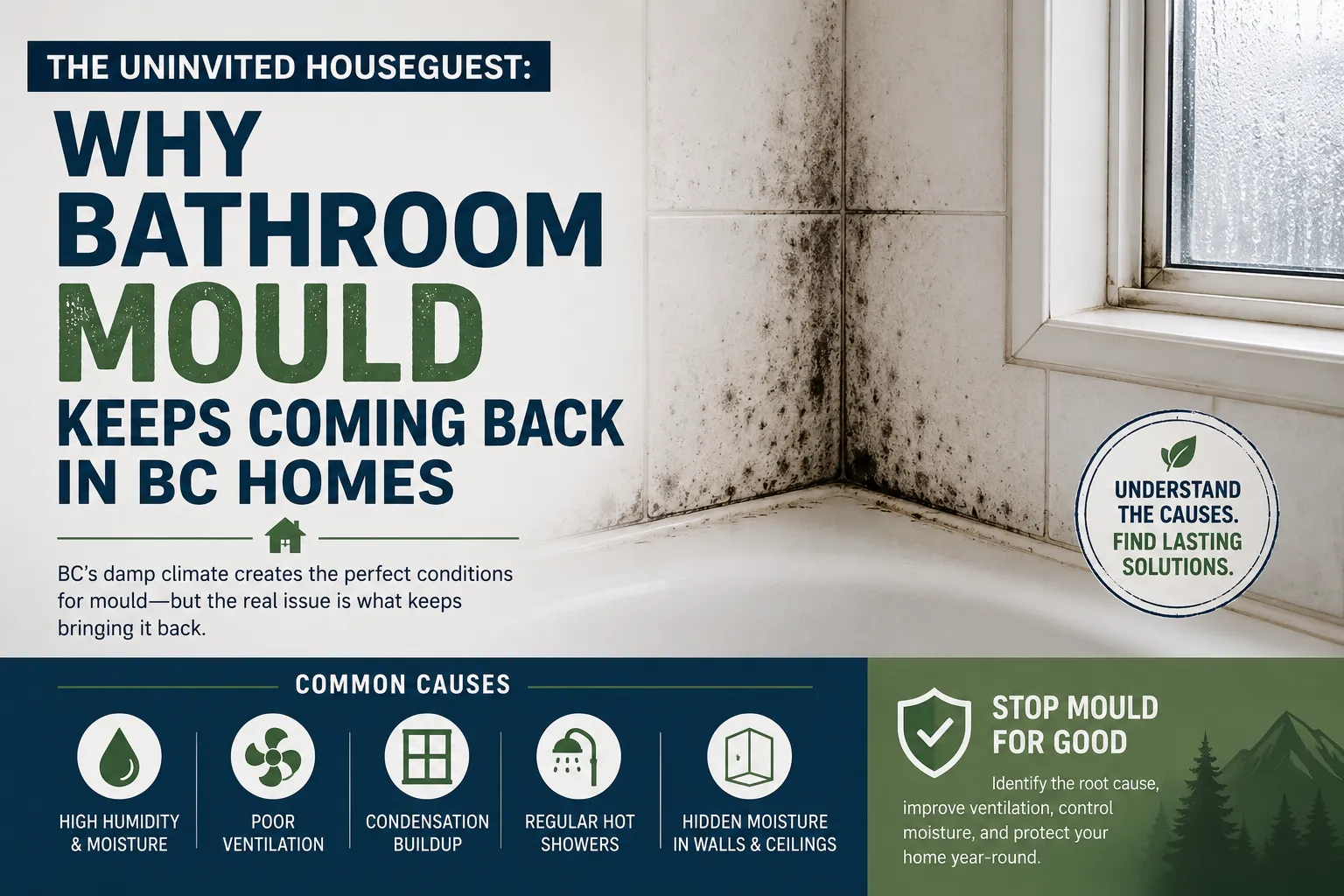
 This tale begins with a shadow-like substance (smudges) at the corner of your bathtub, darkening (blooming) the grout line and/or appearing behind the toilet (dark patch). After scrubbing it off using bleach and elbow grease, you are probably patting yourself on the back, but then you notice the dark patch is back and has grown even darker/bolder and appears angrier.
Is this scenario familiar to you as a homeowner in British Columbia? If so, the coastal, rainy conditions here not only affect the outdoor spaces that we see, but they also affect what lives inside your walls. Bathroom mould is more than an eyesore; it is an ongoing problem that has a very particular history that cannot be altered by merely scrubbing the surface.
Why does bathroom mould remediation continue to thrive in BC homes? Let’s peel back the curtain and find out.
BC’s Climate: A Love Letter to Mould Spores
British Columbia is a very beautiful province, but it is also extremely humid. The weather can be rainy in the Lower Mainland and very misty in the Interior region. So, it’s fair to say that moisture is an integral part of life for most homeowners in British Columbia. The other thing about living in such a humid climate is that it creates a perfect environment for mould spores to grow.
Mould spores exist all throughout your home. There are always mould spores present in the air that you breathe, just waiting for the right conditions (warmth, darkness and moisture) to grow. Your bathroom provides all three of these things every day. After taking a hot shower (which could last well over 10 minutes), the humidity levels in a closed bathroom could reach over 90%. Without adequate humidity control, that water vapour doesn’t completely evaporate or disappear; instead, it settles into all the porous materials (grout, caulking, drywall, and ceiling material) found in your bathroom, thus providing an ideal breeding ground for mould to establish itself permanently.
The Real Culprit: Moisture Intrusion You Can’t Always See
The mold on the surface of walls is one of the indicators you have mold growing within your walls due to excess moisture.
For many homes in BC — especially older homes — the causes of mold problems extend beyond just the tile or grout you can see.
Aging caulk allows water to seep through and accumulate behind the walls or under the flooring and accumulate. Although you clean the visible mold from the surface, there are moisture sources hidden inside your walls that continue to feed the mold network you never knew existed.
That’s why mold is so frustratingly persistent; homeowners focus on fixing what they can see — such as black rings around the faucet base, and grey fuzz along the ceiling — and not the moisture source.
It’s like mopping up a puddle without fixing the leak above.
Moisture intrusion can come from a variety of sources: unsealed shower pans, slow drips behind vanities, condensation from uninsulated exterior walls, or underground moisture from receding ground or from rising damp.
With the rainfall and moisture we have experienced in parts of British Columbia, the sources multiply. Trying to identify what is causing the problem without the assistance of a professional is tantamount to solving a mystery with only half of the clues available.
Ventilation Issues: The Silent Accomplice
When was the last time you checked to see if your bathroom fan actually works? In British Columbia, many homeowners overlook the role of ventilation in their bathrooms when they think of the reasons for mould to grow in that area. Older homes were often constructed without compliant exhaust systems, or the fans vent upwards into the attic instead of outside. This is a very common code violation.
For homes that do have exhaust fans, they may not be adequate for the size of the bathroom, or may have blocked or loose ductwork after many years of use. Hot air from showers or baths, that does not have a way to escape, stays inside of the bathroom, condenses on cold surfaces like tile, mirrors, and walls; causes the drywall on the ceiling to become saturated, and eventually penetrates into the structure of the home. Over time, with ventilation issues in place for your bathrooms, they can act as a breeding ground for mould — and no product you could buy will provide a solution to air being unable to flow. Improving ventilation is the simple answer, but upgrading appliances, ensuring ductwork is properly sealed, and verifying that airflow is compliant with the BC Building Code requires a skilled tradesperson — especially with the complexity of most of the older homes in British Columbia.
Why DIY Solutions Keep Failing
Spraying bleach. Using tea tree oil. Getting a grout pen. Making “mould-resistant” paint. All recently tried by B.C homeowners; however, none of these products were able to eliminate the source(s) of mould. In fact, some D.I.Y. techniques may even create additional problems (i.e., painting over mould would trap spores in walls, repeated applications of bleach would wear down caulking and grout thus increasing the number of cracks/crevice the moisture could get through).
Mould remediation (in bathrooms) is far more than just cleaning up a mess; it’s a comprehensive process that requires identifying all sources of moisture, assessing any damage to the structure caused by mould and cleaning all materials that have been in contact with the mould. If all of these parts are not completed then mould will continue returning because of the same conditions that created it have never been corrected.
What Proper Bathroom Mould Remediation Actually Looks Like
This is where Urban Environmental comes in. Urban Environmental provides expertise in bathroom mould removal in BC homeowners that is dependable and permanent, rather than just a temporary measure. A Certified Remediation Specialist does not simply treat surface-level areas; he/she will perform detailed moisture assessments utilizing state-of-the-art equipment, such as thermal imaging cameras and moisture meters, to identify hidden damp conditions inside walls, floors and ceilings. Remediation specialists will find the source of water intrusion and eliminate it. Once this has been accomplished, they will safely remove all moldy materials from the property. Following this, they will provide clear and practical recommendations about moisture control and ventilation methods to help ensure that mold does not return.
The Urban Environmental approach is based on the understanding of how mold affects not only the structural integrity of buildings, but also how it affects the health of individuals. Mold exposure is known to cause respiratory distress, to aggravate allergies, as well as to cause more serious health issues for susceptible individuals. Given the damp environment of BC’s bathrooms, mold remediation is not an optional expenditure, but rather an essential long-term commitment to securing your home and improving the quality of life for your family.
Breaking the Cycle for Good
Living in beautiful British Columbia should not mean a constant battle with recurring mould problems . Your bathroom mould has more meaning than just being mould — it’s a message for you to understand the problem with moisture, airflow, and the hidden weaknesses of your home’s struc ture. By paying attention to this message you can seek professional help from someone who knows how to diagnose and fix your problem correctly.
Urban Environmental will help BC home owners to break out of the cycle of mould, because bathrooms are meant to be a safe refuge, not an incubator of mould spores. Call today for a professional evaluation, and leave the unwanted guest a message telling it to leave for good.


